
World Cup 2026 Late Night Guide — Surviving the IST Schedule
 Available in US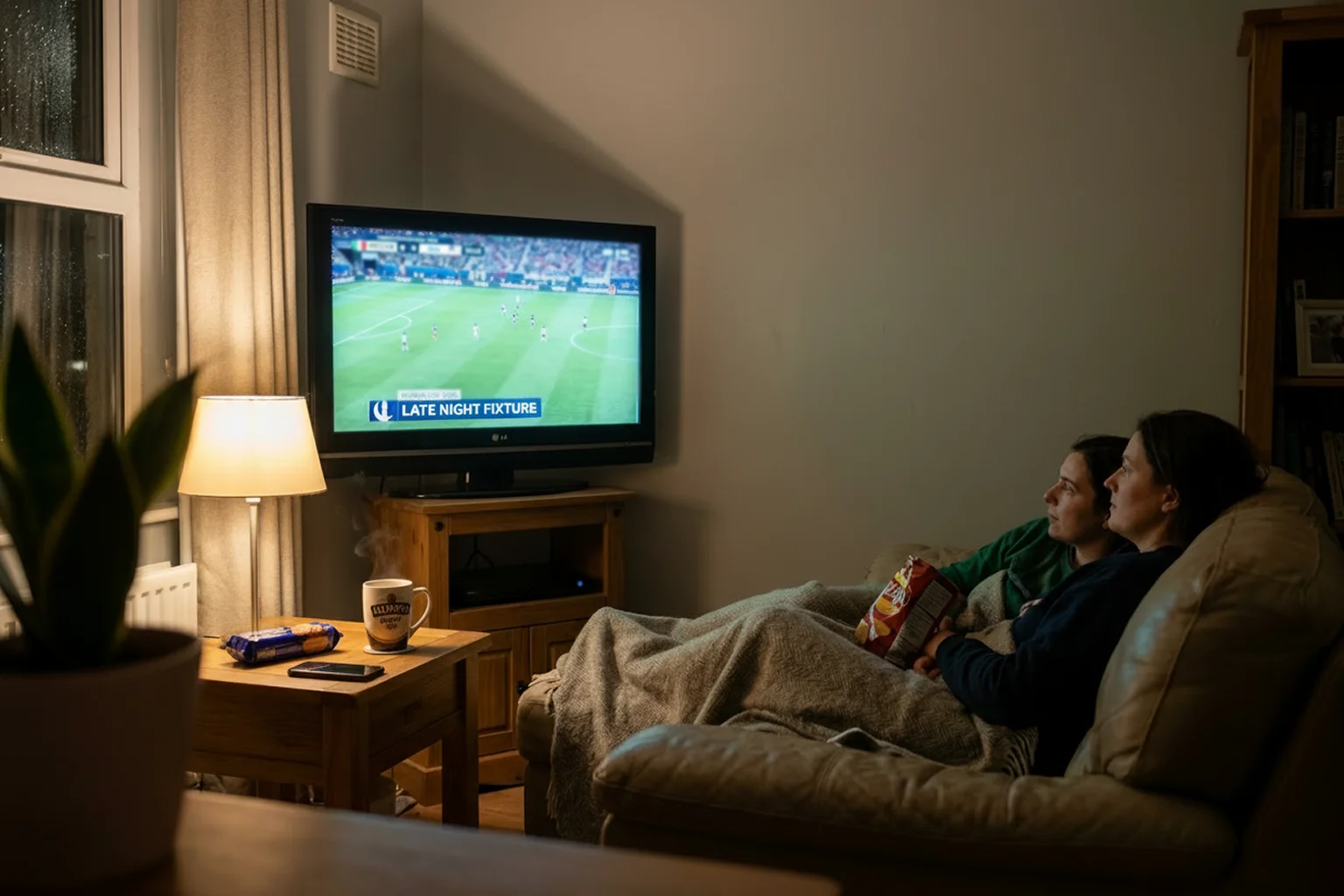
Your alarm goes off at seven in the morning and you feel like you have been dragged behind a bus. Your eyes are red, your head is fuzzy and your phone shows three notifications from mates who watched the same match and are equally destroyed. Welcome to the 2026 World Cup from Ireland — a tournament played across three North American time zones that will turn every Irish football fan into a reluctant night owl for the better part of six weeks. I have covered three major tournaments from Irish Standard Time, and the scheduling challenge of a North American World Cup is unlike anything we have faced before.
The IST Problem — ET to Irish Time
During the tournament window of 11 June to 19 July 2026, Ireland operates on Irish Standard Time, which is UTC+1 — the same as British Summer Time. The majority of World Cup matches will be played in the Eastern, Central and Pacific time zones of the United States, and the conversion is brutal for fans on this side of the Atlantic.
Eastern Time is five hours behind IST during summer. A match kicking off at 18:00 ET — the earliest evening slot — starts at 23:00 IST. A match at 21:00 ET starts at 02:00 IST the following day. Matches on the West Coast of the United States kick off even later: a 17:00 PT start at Levi’s Stadium in Santa Clara converts to 01:00 IST, and a 19:30 PT start reaches Ireland at 03:30 IST.
The Mexican venues offer slightly more palatable scheduling. Mexico City is six hours behind IST, meaning a 17:00 CDT kick-off at Estadio Azteca converts to 23:00 IST — late, but survivable for a midweek match. The opening match on 11 June, Mexico vs South Africa, is expected to kick off in the early evening Mexican time, placing it around 23:00 to midnight IST. That sets the tone for the entire tournament: this World Cup starts late and stays late.
The Canadian venues — Toronto and Vancouver — span the same time zone challenge. Toronto is in Eastern Time, so the same five-hour gap applies. Vancouver is in Pacific Time, eight hours behind IST, which means evening matches in BC Place start in the early hours of the Irish morning. If a match you care about is scheduled for Vancouver, clear your calendar for the following morning.
When Do the Big Matches Kick Off?
The group-stage schedule runs from 11 June to approximately 28 June 2026, with multiple matches per day. The early kick-off slots — typically 12:00 to 14:00 ET — convert to 17:00 to 19:00 IST, which is the one piece of scheduling mercy in the entire tournament. Group-stage afternoon matches in the Eastern and Central time zones will be watchable at teatime in Ireland, and these slots tend to feature the less high-profile fixtures. If your interest is broad rather than focused on specific teams, the afternoon IST slots will keep you entertained without destroying your sleep.
The marquee group-stage matches — the ones involving major contenders — are scheduled for the prime-time evening slots in North America. For Ireland, that means England’s Group L matches will kick off between 23:00 and 02:00 IST. Scotland’s Group C fixtures, including the much-anticipated match against Brazil, are likely to fall in the same window. If you want to watch the teams that matter most to Irish fans, you are staying up past midnight for every match.
The knockout rounds tighten the schedule. From the round of 32 onward, matches are concentrated in the evening slots to maximise the North American television audience, which means almost every knockout match kicks off between 23:00 and 02:00 IST. The semi-finals and the final at MetLife Stadium will be scheduled for prime-time Eastern Time — likely 20:00 or 21:00 ET, which converts to 01:00 or 02:00 IST. If Ireland had qualified and reached the semi-finals, the entire nation would have been awake at two in the morning. As neutrals, the decision to stay up becomes a personal cost-benefit analysis for each fixture.
The Irish Fan’s Late Night Survival Guide
I learned the hard way at the 2014 World Cup in Brazil — similar time zones, similar scheduling — that watching every late match is unsustainable. By the second week I was a zombie, my analysis suffered, and I made a spectacularly bad betting decision at 02:00 that I blame entirely on sleep deprivation. The lesson: you cannot watch everything, so you need a system for deciding what to watch live and what to catch up on the following morning.
My system is tiered. Tier one: matches I watch live no matter what. These are the fixtures involving teams I have backed in the outright or group-winner markets, plus any match with genuine upset potential that could move the odds board. For the 2026 World Cup, my tier-one matches include every England group match (cultural obligation as an Irish analyst), every Japan group match (I have backed them in multiple markets), and the Brazil vs Morocco fixture in Group C (the match that determines Scotland’s fate). That is roughly eight to ten late nights across the group stage, which is manageable.
Tier two: matches I record and watch the following morning before checking the results. These are fixtures I am interested in but that do not directly affect my bets or my analysis. Most group-stage matches involving smaller nations fall into this category. The key is avoiding spoilers — mute the group chats, stay off social media, and watch the recording as if it were live. It requires discipline, but the alternative is watching fifty consecutive late nights and arriving at the knockout rounds unable to think straight.
Tier three: results only. Some matches are simply not worth the sleep sacrifice. Curaçao vs Ecuador at 02:00 IST on a Tuesday is tier three unless you have a specific betting interest. Check the score in the morning, note any surprises and move on.
Practical tips: stock the fridge before the tournament starts — you will be eating dinner at eleven at night for six weeks. Invest in a good recording setup or streaming service that allows pause and rewind. Tell your employer in advance that you will be slightly less sharp in the mornings during June and July — or better yet, take your holidays during the knockout rounds. And above all, pick your battles. The World Cup lasts 39 days, and no human being can maintain a 02:00 bedtime for 39 consecutive nights.
Late Kick-Offs and In-Play Betting — A Night Owl’s Edge
Here is the silver lining of the IST schedule: the late matches create an in-play betting edge for the dedicated Irish punter. At 02:00 IST, the casual European betting public is asleep. The in-play markets are thinner — fewer bets are being placed, which means the odds react more slowly to events on the pitch. A goal at the 60th minute in a 02:00 IST match will move the in-play odds, but the movement is less sharp and less efficient than it would be at 20:00 IST when millions of Europeans are watching and betting simultaneously.
That inefficiency is exploitable. If you are watching a late match live and you see a tactical substitution that changes the game’s dynamic, the in-play odds may not adjust for several minutes. A team that brings on a fresh striker at the 70th minute when trailing 1-0 is suddenly more likely to score, but the in-play market — thinly traded at 03:15 IST — may lag in reflecting that shift. The night owls who are awake, watching and ready to act have a window of opportunity that daytime viewers never experience.
I exploited this edge at the 2014 World Cup, where matches in Manaus and Cuiaba kicked off at similarly unsociable hours for European audiences. The in-play markets for those late matches were consistently less efficient than the prime-time fixtures, and my in-play betting record during the Brazilian graveyard shift was my best of the tournament. The 2026 World Cup will present the same opportunity on a larger scale — 104 matches, many of them at times when the European betting public is in bed.
The practical requirement is a funded account with a bookmaker that offers comprehensive in-play markets and fast odds updates. Pre-tournament preparation should include identifying which bookmakers offer the deepest in-play coverage for World Cup matches and testing their platform speed during late-night fixtures in the weeks before the tournament. A two-second delay in odds updates at 02:00 IST could be the difference between capturing an edge and missing it.
The Matches Worth Staying Up For
Not every late night is created equal. Some matches justify the sacrifice; others do not. Here is my shortlist of fixtures that I will be watching live regardless of the IST kick-off time, and my reasoning for each.
Brazil vs Morocco in Group C. The match that determines whether Scotland have any hope of qualifying and one of the most compelling tactical matchups in the group stage. Two of the best sides in the 2022 World Cup, both improved since, meeting in a group where the result shapes the entire bracket path. Non-negotiable viewing.
England vs Croatia in Group L. A rematch of the 2018 World Cup semi-final, played with the added spice of group-stage jeopardy. England are favourites, but Croatia’s tournament pedigree means this match could go either way. If you have any outright or group bets involving England, you need to watch this live.
Netherlands vs Japan in Group F. My predicted group of death’s marquee fixture. Japan’s pressing against Dutch possession is the tactical matchup of the tournament, and the result will determine which side takes control of the group. This is the match where in-play betting edges are most likely to appear, because the tactical chess match will produce momentum shifts that the odds market cannot anticipate.
USA vs Turkey in Group D. The hosts against a golden generation of Turkish talent, played in front of a home crowd that will be desperate for a statement result. The atmosphere will be extraordinary, and the match carries implications for group supremacy that affect the entire bracket. Worth the late night for the spectacle alone.
And the final, of course. MetLife Stadium, 19 July 2026. Whatever time it kicks off in Ireland — almost certainly after midnight IST — the World Cup final is the one match where sleep is not even a consideration. If my predictions are right and Brazil are involved, I will be watching from the edge of my seat with a betting slip in one hand and a very strong coffee in the other. For comprehensive answers to scheduling and format questions, the full FAQ covers every common query about the tournament.
Gambling involves risk. Over 18s only. Gamble responsibly.
What time do World Cup 2026 matches kick off in Ireland?
Most group-stage matches kick off between 17:00 and 02:00 IST (Irish Standard Time, UTC+1). Early afternoon matches in North America convert to early evening in Ireland, but prime-time evening matches start at 23:00 IST or later. Knockout-round matches are concentrated in evening slots, meaning most start between 23:00 and 02:00 IST.
What is the time difference between Ireland and the World Cup host cities?
Ireland is five hours ahead of Eastern Time (New York, Miami, Toronto), six hours ahead of Central Time (Dallas, Houston, Mexico City), seven hours ahead of Mountain Time (no host cities in this zone) and eight hours ahead of Pacific Time (Los Angeles, Seattle, Vancouver) during summer.
What time is the World Cup 2026 final in Irish time?
The final at MetLife Stadium in New Jersey is expected to kick off between 20:00 and 21:00 Eastern Time, which converts to 01:00 or 02:00 IST on the morning of 20 July 2026. The exact kick-off time will be confirmed closer to the tournament.
