
Hard Rock Stadium — World Cup 2026 Miami Venue
 Available in US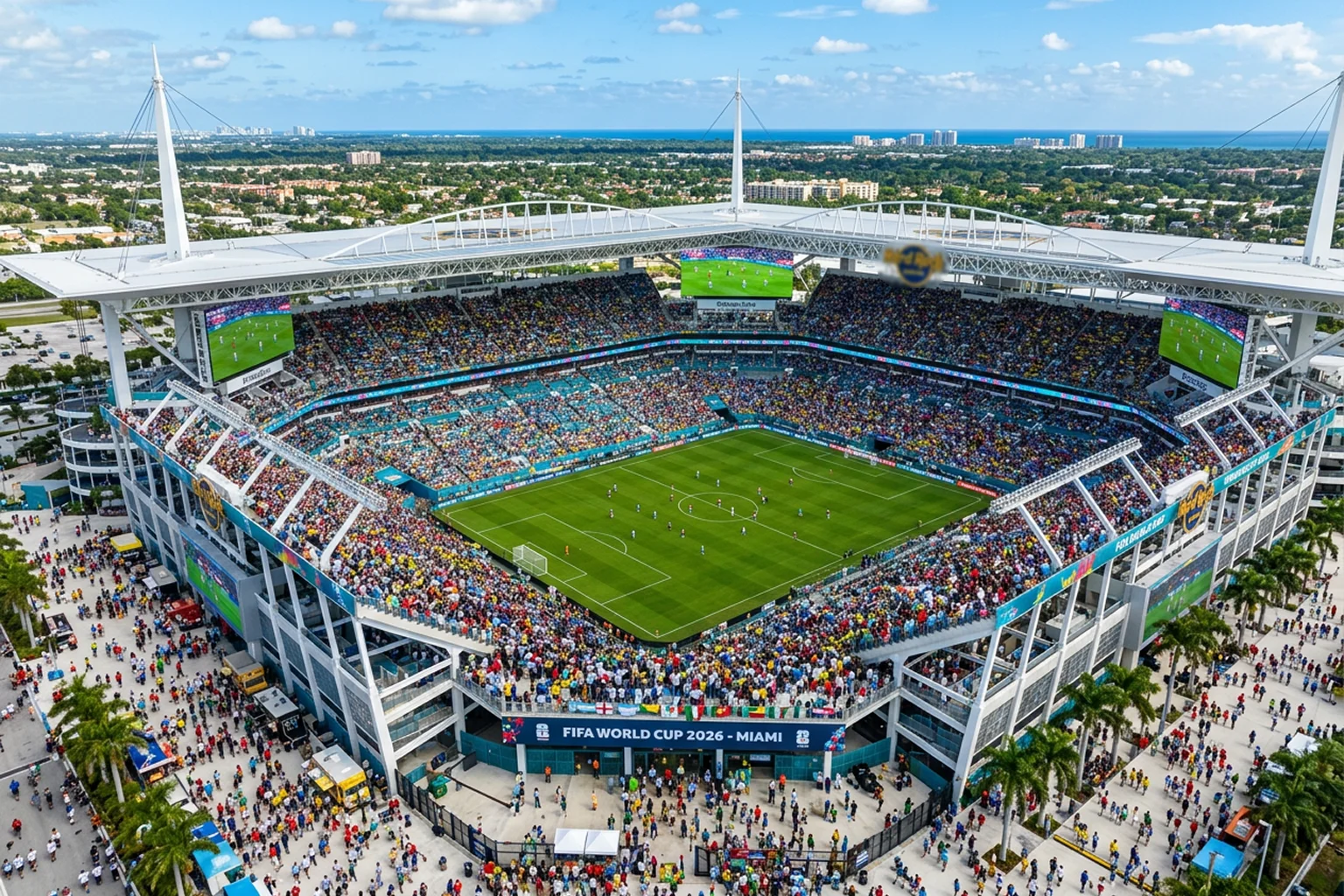
Miami in June is not for the faint-hearted. I have covered football matches in warm climates across three continents, and nothing quite prepares you for the wall of humidity that greets you when you step off a plane at Miami International. The air is thick, the temperature rarely drops below 28 degrees Celsius even after dark, and the sensation of breathing through a warm, wet blanket persists from dawn to well past midnight. Hard Rock Stadium sits in the middle of this subtropical furnace, and for the teams assigned to play World Cup 2026 fixtures here, the heat is not an inconvenience — it is a tactical weapon that will shape outcomes, influence betting markets and separate the prepared from the unprepared.
Hard Rock Stadium is one of 11 US venues hosting World Cup matches, and its location in Miami Gardens — roughly 25 kilometres north of downtown Miami — places it at the heart of one of America’s most football-obsessed regions. The Miami area’s enormous Latin American population ensures that any match involving a South American or Central American team will feel like a home fixture for the visitors, a dynamic that creates fascinating opportunities for bettors who understand how crowd energy affects results.
Hard Rock Stadium — Key Facts
Hard Rock Stadium opened in 1987 as Joe Robbie Stadium and has undergone multiple renovations, most recently a $550 million overhaul completed in 2016 that added a partial canopy roof structure, luxury suites and modernised facilities. The stadium serves as the home of the Miami Dolphins NFL franchise and has hosted six Super Bowls, multiple college football championships and the Miami Open tennis tournament. Its football capacity sits at approximately 65,000, which makes it one of the smaller World Cup venues — but the intimate bowl design amplifies noise in a way that compensates for the reduced headcount.
The canopy roof, added during the 2016 renovation, covers approximately 92% of the seating areas while leaving the playing field exposed to the elements. This design protects spectators from rain and direct sun while allowing natural airflow across the pitch — a critical consideration in Miami’s humidity. The canopy does not fully enclose the stadium, which means wind patterns during afternoon thunderstorms can push rain onto sections of the playing surface. For bettors tracking in-play conditions, the exposed pitch is the key variable: a sudden downpour in the second half can transform a fast, technical match into a scrappy, physical contest within minutes.
The playing surface for the World Cup will be natural grass, replacing the current setup at the stadium. Miami’s climate is actually favourable for maintaining grass quality — the combination of warmth, sunshine and regular rainfall promotes rapid growth — but the challenge is drainage. South Florida sits on a limestone bedrock that limits natural drainage, and Hard Rock’s pitch relies on an engineered sub-surface system to remove standing water quickly. If that system works as designed, the surface should be among the best at the tournament. If it struggles during a heavy rain event — and Miami thunderstorms can dump 50mm of rain in 30 minutes — the pitch could deteriorate rapidly.
The stadium’s location in Miami Gardens sits within the broader Miami-Fort Lauderdale metropolitan area, which is home to over six million people and one of the most culturally diverse populations in the United States. For World Cup purposes, this diversity translates directly into crowd composition. A match involving Argentina at Hard Rock would draw tens of thousands of Argentine fans from the local community. A Colombia fixture would pack the stadium with yellow shirts. Even a match involving a smaller South American nation — Paraguay, Ecuador, Uruguay — would attract a passionate diaspora crowd that turns a neutral venue into a home ground. Understanding this dynamic is essential for any bettor assessing match odds at Hard Rock.
World Cup Matches in Miami
Hard Rock Stadium will host group stage matches and at least one knockout round fixture, though the exact allocation depends on FIFA’s final scheduling. The venue’s location on the US East Coast means kick-off times are more manageable for Irish viewers than west coast fixtures — a 19:00 ET start translates to midnight IST, and a 16:00 ET kick-off means 21:00 IST. For any Irish fan trying to watch every match at this tournament, the Miami fixtures offer a relative reprieve from the 03:00 and 04:00 starts that west coast venues demand.
The group stage fixtures at Hard Rock are likely to feature at least one South American team, given Miami’s cultural alignment and the commercial logic of placing Latin American sides in front of passionate local crowds. This has direct betting implications: a South American team playing in Miami effectively has a home crowd advantage that is not captured in the standard odds. If Argentina draw a group match at Hard Rock, the roar of 65,000 Argentine fans in southern Florida would rival anything in Buenos Aires. The bookmakers will adjust for venue, but in my experience, they consistently underestimate the crowd factor at stadiums with strong diaspora presence.
Knockout round matches at Hard Rock carry additional intrigue. A round of 32 or quarter-final fixture played in Miami’s heat and humidity creates a physical test that favours teams from warm climates. European sides that have spent the group stage at cooler northern US venues — Seattle, Boston, Philadelphia — and then travel to Miami for a knockout match face an acclimatisation challenge that can cost them dearly. The transition from 18 degrees in Seattle to 33 degrees in Miami is equivalent to moving between different planets, and a team that has not prepared for the shift will fade in the second half.
The Heat Factor — What It Means for Betting
Here is the number that should guide every bet you place on a Hard Rock Stadium fixture: 33. That is the average high temperature in degrees Celsius in Miami during June and July, and when you combine it with humidity that regularly exceeds 75%, you get a heat index — the “feels like” temperature — that can reach 40 degrees or higher. These are conditions that physically degrade athletic performance. Studies on football in extreme heat show a measurable reduction in total distance covered, high-intensity sprints and sprint recovery time when the heat index exceeds 35 degrees. Players drink more, cramp more, and make more errors in the final 20 minutes of each half.
The tactical implications are significant. High-pressing teams — the kind that run 12 or 13 kilometres per player per match in European conditions — cannot sustain that output in Miami’s heat. The energy cost of a 100-metre sprint at 33 degrees with 75% humidity is roughly 15% higher than the same sprint at 20 degrees with 40% humidity. Over 90 minutes, that accumulates into a substantial physical deficit. Teams that play a more measured, possession-oriented game — controlling tempo, reducing transitions, keeping the ball away from the opposition rather than hunting it aggressively — are better equipped for these conditions.
For bettors, the heat factor at Hard Rock creates specific opportunities. First, the under goals market gains value in fixtures between two European teams playing at Hard Rock. The physical drain will reduce attacking intensity in the second half, and matches that are level at halftime are more likely to stay level or produce only one late goal. Second, the halftime-fulltime market rewards patience: teams that trail at halftime in Miami’s heat have a harder time mounting comebacks because the physical cost of chasing the game increases exponentially as fatigue compounds. A bet on the halftime leader to win the match carries a stronger edge at Hard Rock than at any other venue in the tournament. Third, player-specific markets — particularly cards and substitutions — are influenced by the conditions. Tired players commit more fouls, and managers at this level will use all five substitution slots by the 75th minute. Over 4.5 cards in a match is a market worth exploring for every Hard Rock fixture.
The rain factor adds a layer of unpredictability that experienced bettors can exploit. Miami afternoon thunderstorms arrive with dramatic speed — clear skies at 14:00 can become torrential rain by 15:00 and clear again by 16:00. A match scheduled for a late afternoon kick-off has the highest probability of being affected by rain, and the in-play markets will react to changing conditions with a lag that creates arbitrage opportunities. If rain hits at the 55th minute of a level match, the under goals market will tighten slowly — but the probability shift is immediate, and a quick in-play bet can capture value before the market adjusts.
My Venue Rating
Hard Rock Stadium gets a 7/10 overall. The atmosphere score is an 8 — the intimate bowl design and the Latin American crowd factor combine to create an environment that is louder and more passionate than the 65,000 capacity might suggest. The pitch score is a 6 — the climate supports grass growth, but the drainage risk during thunderstorms introduces uncertainty. The betting relevance score is a 9 — the highest I give to any venue at this tournament. The heat, the humidity, the crowd composition and the weather unpredictability create more exploitable betting angles per match than any other stadium on the schedule.
For Irish punters building a tournament-long strategy, Hard Rock Stadium is the venue where preparation pays the biggest dividend. Know the weather forecast for each match day. Know which teams have acclimatised and which have not. Know the diaspora composition of the crowd. And know that the heat is the invisible player on the pitch — it does not score goals, but it decides who has the energy to score them in the 85th minute.
For the complete breakdown of all 16 World Cup venues, including atmosphere scores, pitch ratings and betting relevance for each location, see my full venue ratings guide.
How hot is Miami during the World Cup in June and July?
Average high temperatures in Miami during June and July reach 33 degrees Celsius, with humidity regularly exceeding 75%. The heat index — the perceived temperature factoring in humidity — can reach 40 degrees or higher, creating conditions that significantly affect player performance and match outcomes.
Does Hard Rock Stadium have a roof?
Hard Rock Stadium has a partial canopy that covers approximately 92% of the seating areas but leaves the playing field exposed. This protects spectators from rain and sun while allowing airflow, but the pitch is subject to weather conditions including Miami"s frequent afternoon thunderstorms.
What time do Hard Rock Stadium matches kick off in Irish time?
Hard Rock Stadium is on US Eastern Time, which is five hours behind IST during summer. A 19:00 ET kick-off translates to midnight IST, and a 16:00 ET start means 21:00 IST — among the most manageable times for Irish viewers at this tournament.
