
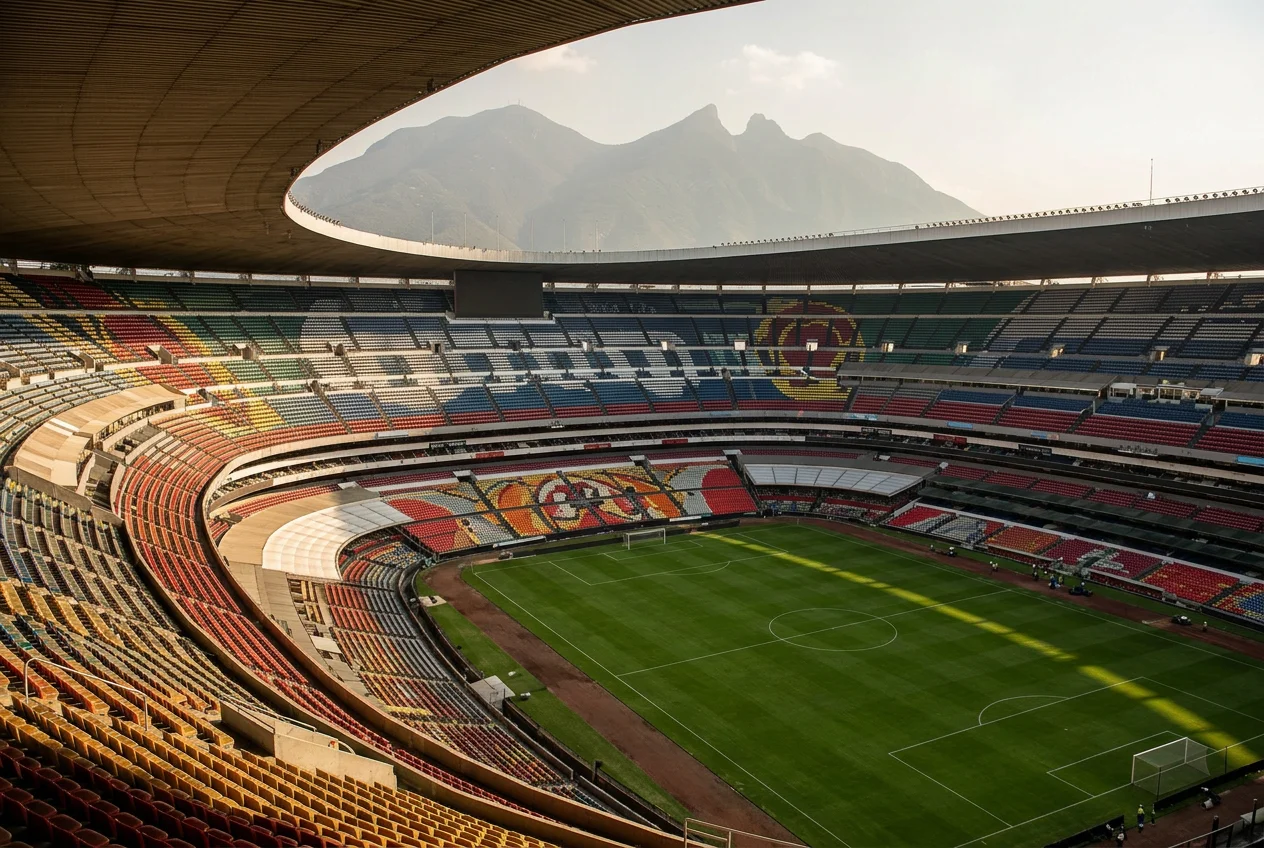
Estadio Azteca — World Cup 2026 Opening Ceremony Venue
Loading...
There is a moment, about ten minutes before kick-off at Estadio Azteca, when the noise builds to a frequency you feel in your chest rather than hear with your ears. I experienced it during a Liga MX match in 2019 — a regular-season fixture, nothing special by Mexican standards — and the memory has not faded. Over 80,000 people, generating a sound that bounces off the concrete bowl and hits you from every direction at once. Now imagine that multiplied by the weight of a World Cup opening ceremony, a nation’s pride, and the knowledge that every football fan on the planet is watching. Estadio Azteca on 11 June 2026 will be the loudest place in world sport.
This stadium has hosted two World Cup finals — 1970 and 1986 — and the opening match of the 2026 tournament adds another chapter to a history that no other venue can rival. Mexico versus South Africa, under the lights at the Azteca, at an altitude of 2,240 metres above sea level. For bettors, that altitude is not a footnote — it is the single most important environmental variable at any World Cup 2026 venue.
Estadio Azteca — A Legendary History
Built in 1966 and opened just in time for the 1970 World Cup, Estadio Azteca was designed by architects Pedro Ramirez Vazquez and Rafael Mijares Alcerreca as a monument to Mexican football ambition. It was, at the time, the largest football stadium in the Americas, and its distinctive three-tier bowl — steep, intimate and ferociously loud — became the template for modern stadium design across Latin America.
The 1970 World Cup final between Brazil and Italy remains one of the greatest matches ever played, and it happened here. Pele’s fourth goal in that 4-1 victory — a header from Jairzinho’s cross — is replayed on the stadium’s screens before every international match, a reminder of what this pitch has witnessed. Sixteen years later, Diego Maradona produced both the “Hand of God” and the “Goal of the Century” against England in the 1986 quarter-final at the Azteca, two moments that define football’s relationship with genius and controversy in equal measure.
The stadium has undergone significant renovation ahead of the 2026 tournament. Capacity has been adjusted to approximately 83,000, new seating has been installed throughout the lower bowl, and the playing surface has been completely relaid to meet FIFA’s standards. The renovations also include upgraded floodlighting, modern broadcast facilities and improved access points designed to reduce the crush that has historically accompanied big matches at the venue. For Irish fans with memories of Lansdowne Road before the Aviva was built, the comparison is apt — the Azteca is being modernised without losing the rawness that makes it special.
Altitude is the Azteca’s defining characteristic and the element that separates it from every other World Cup venue. At 2,240 metres above sea level, the air in Mexico City contains roughly 20% less oxygen than at sea level. For players arriving from low-altitude countries — virtually every European and most South American nations — the effect is immediate and measurable. Heart rates increase, breathing becomes laboured during high-intensity sprints, and recovery between efforts slows noticeably. Teams that have not acclimatised, typically requiring a minimum of five to seven days at altitude, suffer visibly in the second half of matches. Mexico, whose players train and compete at altitude throughout their careers, enjoy a physiological advantage that is worth at least half a goal per match. The bookmakers know this, and Mexico’s odds for fixtures at the Azteca are consistently shorter than their odds at sea-level venues.
The weather in Mexico City during June adds another layer. Afternoons in June frequently bring dramatic thunderstorms — heavy rain, lightning and a sudden drop in temperature that can transform playing conditions within minutes. Morning and evening fixtures are typically clear and warm, with temperatures around 22 to 26 degrees Celsius. The rainy season factor is underappreciated by European bettors: a match that starts in sunshine can become a waterlogged affair by the 60th minute, changing the tactical dynamic entirely. Teams that play on the ground — short passing, quick combinations — are more affected by wet conditions at altitude, where the ball moves differently through thinner air on a slick surface.
2026 World Cup Matches at the Azteca
Estadio Azteca hosts the tournament’s opening match — Mexico versus South Africa on 11 June 2026 — along with additional Group A fixtures and knockout round matches. The exact number of fixtures depends on FIFA’s final scheduling, but the Azteca is guaranteed at least five or six matches across the tournament, making it one of the busiest venues.
The opening match carries enormous symbolic weight. Mexico have not won an opening World Cup fixture since 2018, and the pressure of performing at home in the very first match of a tournament co-hosted by their nation will be intense. South Africa, the opponent, are the lowest-ranked team in Group A and will be treated by the Mexican public as a formality — which creates exactly the kind of complacency that produces shock results. From a betting standpoint, Mexico to win the opening match is priced short enough to offer little value, but the correct score and total goals markets deserve attention. Opening matches at World Cups are historically tight, low-scoring affairs: the average goals per game in opening fixtures across the last ten World Cups is 2.1, significantly below the tournament average. A bet on under 2.5 goals in Mexico versus South Africa is my preferred angle.
The knockout round fixtures at the Azteca will be among the most atmospheric of the entire tournament. Any team drawn to play at the Azteca in the round of 32 or beyond faces an environment that most European sides have never experienced — the combination of altitude, noise and an overwhelmingly Mexican crowd creates conditions that are closer to an away fixture for visiting teams than a neutral venue should be.
The Opening Night — Mexico vs South Africa
Every opening match of a World Cup carries a specific tension: it is the moment where four years of preparation, qualifying campaigns and tactical planning meet reality. The players know the entire world is watching, and that awareness produces cautious, nervy football more often than expansive attacking displays. Mexico versus South Africa will follow this pattern. Mexico will dominate possession, South Africa will defend deep and try to hit on the counter, and the Azteca crowd will grow increasingly frustrated if the breakthrough does not come quickly.
Mexico’s tactical approach at home tends towards patience. They build through midfield, stretch play with wide attackers, and rely on individual moments of quality to break stubborn defensive blocks. South Africa, under their current coaching setup, play with a compact low block that concedes territory but protects the central areas. The clash of styles points towards a match that is decided by a single goal — either a Mexico set piece, a South African counter-attack, or an individual error under the pressure of 83,000 people willing a result.
For Irish viewers, the opening match is a chance to soak in the World Cup atmosphere without the emotional investment that England or Scotland fixtures demand. It is a night to enjoy the spectacle, assess the conditions at the Azteca, and perhaps place a small bet on the match going under 2.5 goals at odds that typically sit around 4/5. The altitude, the occasion and the tactical conservatism of opening fixtures all point in the same direction: a cagey, intense and ultimately low-scoring start to the tournament.
Mexico City — Beyond the Stadium
Mexico City is one of the great cities of the world, and any Irish fan fortunate enough to attend a match at the Azteca should budget extra days to explore. The city’s food scene alone justifies the trip — from street-stall tacos al pastor to fine dining that rivals anything in Europe — and the cultural landmarks, from Frida Kahlo’s Casa Azul to the vast Zocalo plaza, offer experiences that most World Cup host cities cannot match.
The Irish connection to Mexico City is smaller than to New York or Boston, but it exists. A handful of Irish pubs operate in the Polanco and Condesa neighbourhoods, and the broader expat community ensures that finding fellow World Cup tourists from Dublin or Galway will not be difficult. Flight connections from Dublin require a stop — typically through Dallas, Houston or Miami — and the total journey time of 14 to 16 hours is manageable for a long weekend trip if you plan around the match schedule.
Safety is the question every European traveller asks about Mexico City, and the honest answer is that the city’s tourist areas are safe, well-policed and entirely manageable for anyone who exercises the same common sense they would in any large city. The areas around the Azteca — Coyoacan and the southern neighbourhoods — are among the city’s safest and most charming. Stay in established tourist zones, use registered taxis or ride-hailing apps, and you will find a city that is welcoming, vibrant and utterly unlike anything in Europe.
My Venue Verdict
Estadio Azteca is a 10/10 for atmosphere — the only perfect score I give to any venue at this tournament. The history, the altitude, the noise and the renovation combine to create an experience that no other stadium on the World Cup circuit can replicate. The pitch scores a 7 — the relaid surface should be excellent, but the altitude and potential rain introduce variables that affect ball flight and player performance in unpredictable ways. Betting relevance earns a 9 — the altitude factor alone makes every Azteca fixture a market worth studying carefully.
If I could attend one match at the entire World Cup, it would be at the Azteca. The opening night, the history pressing down from every concrete tier, the sound that hits you in the chest — this is what a World Cup should feel like. For anyone placing bets on fixtures at this venue, remember the altitude above everything else. It is the invisible player on the pitch, and it does not wear a shirt.
For the full story of Group A and how Mexico’s home advantage shapes the tournament, my dedicated group preview covers every fixture, every betting angle and every tactical consideration for the group that opens the 2026 World Cup.
How does altitude affect matches at Estadio Azteca?
Estadio Azteca sits at 2,240 metres above sea level, where the air contains approximately 20% less oxygen than at sea level. Players from low-altitude countries experience increased heart rates, faster fatigue and slower recovery between sprints. Teams that have not acclimatised for at least five to seven days suffer visibly, particularly in the second half. Mexico enjoy a significant physiological advantage at this venue.
When is the 2026 World Cup opening match at Estadio Azteca?
Mexico versus South Africa on 11 June 2026 is the tournament"s opening fixture. The kick-off time has not been finalised, but an evening start in Mexico City would translate to approximately 01:00 IST for Irish viewers due to the six-hour time difference.
Has Estadio Azteca hosted a World Cup Final before?
Estadio Azteca has hosted two World Cup finals: the 1970 final between Brazil and Italy and the 1986 final between Argentina and West Germany. It is the only stadium in the world to have hosted two World Cup finals, and the 2026 tournament adds to its unmatched legacy.