
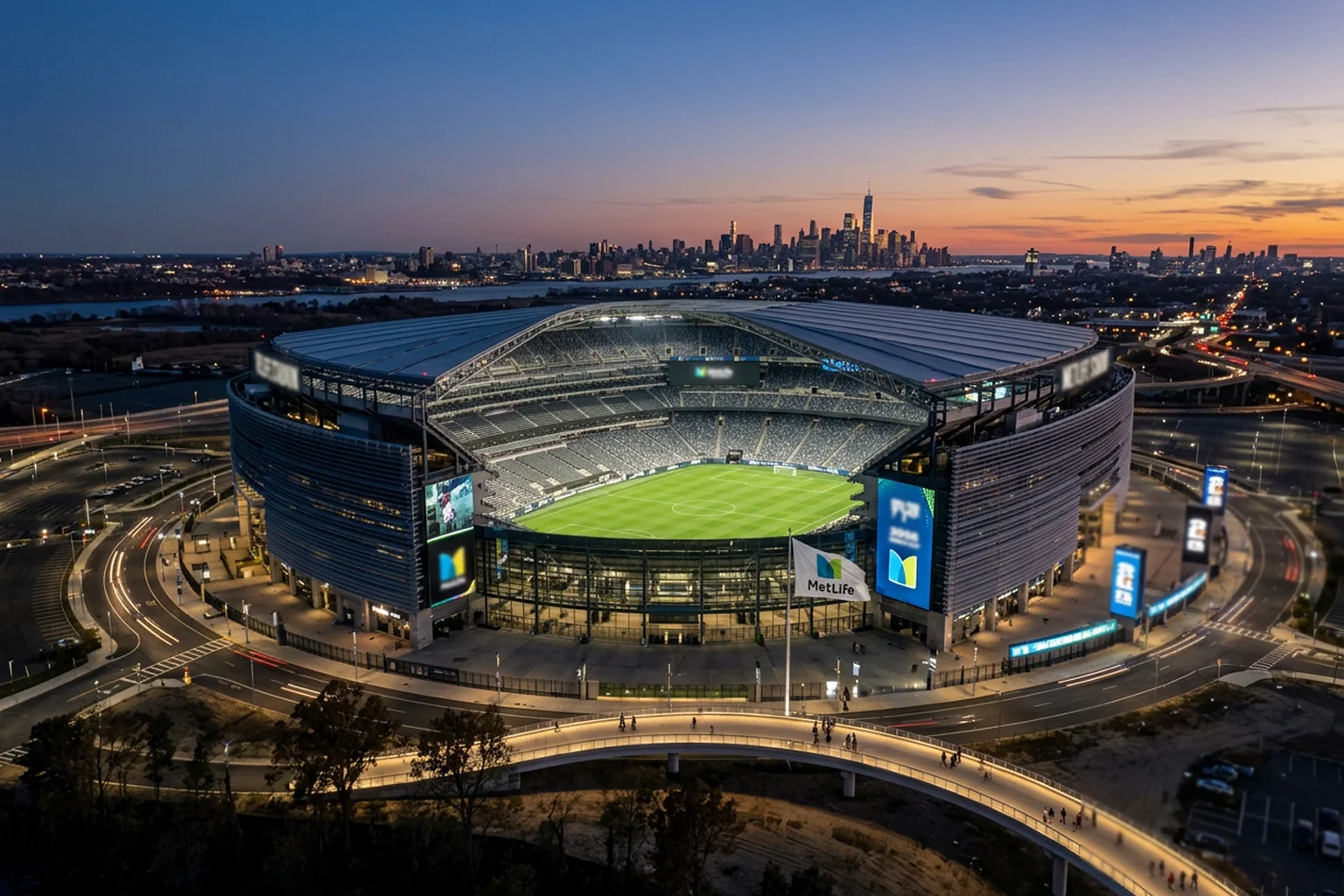
MetLife Stadium — World Cup 2026 Final Venue Guide
Loading...
I have been inside MetLife Stadium twice for American football and once for a Copa America match, and each time the sheer scale of the place hit differently. It is not beautiful in the way Estadio Azteca is beautiful, nor architecturally striking the way SoFi Stadium demands attention. MetLife is functional, enormous, and built to handle the biggest events American sport can produce. On 19 July 2026, it will host the biggest match in world football — the FIFA World Cup Final — and every punter placing a long-range outright bet needs to understand what this venue means for the teams that reach it.
The choice of MetLife over SoFi or AT&T Stadium is telling. FIFA wanted the final in the New York metropolitan area — the media capital of the world, the largest city in the United States, and a hub for the kind of global attention that a World Cup final demands. That the stadium itself is technically in East Rutherford, New Jersey, rather than New York City proper is a detail that bothers geography purists and no one else. For the purposes of this tournament, MetLife is New York’s stadium, and the final will carry the weight of that city’s energy.
MetLife Stadium — The Numbers
MetLife Stadium opened in 2010 as the home of the New York Giants and New York Jets — two NFL franchises sharing a single venue, which gives you an immediate sense of its capacity. The stadium holds approximately 82,500 spectators for football events, though FIFA’s configuration for the World Cup may adjust that figure slightly depending on pitch dimensions, media requirements and VIP allocations. Even with adjustments, the atmosphere generated by 80,000-plus fans in a closed-bowl design will be immense.
The playing surface is natural grass — a departure from the artificial turf used for NFL games. FIFA requires all World Cup venues to install natural grass pitches, and MetLife will undergo a surface conversion in the months before the tournament. This is significant for betting purposes: the quality of a hastily installed natural pitch in a stadium designed for artificial turf can be unpredictable. At the 2015 Copa America held at MetLife, the pitch deteriorated noticeably during matches, and players from several teams complained about the surface. FIFA has invested heavily in ensuring this does not happen in 2026, but the risk is worth noting for any in-play bettor assessing conditions during the final.
The stadium is an open-roof venue, which means weather becomes a factor. Mid-July in the New York area brings heat, humidity and the possibility of afternoon thunderstorms. A final scheduled for an evening kick-off — the standard slot for the showpiece match — would avoid peak heat, but humidity in the high 70s to low 80s Fahrenheit is entirely possible even after sunset. For European teams accustomed to cooler conditions, this is a physical challenge. For South American or African sides, it may be an advantage. The weather angle is underpriced in most outright markets, and it is one of the factors I weigh when assessing which teams are best equipped for a deep run.
Transport infrastructure around MetLife is a known challenge. The stadium sits in the Meadowlands complex, accessible primarily by car or the NJ Transit rail link from Penn Station in Manhattan. On match days, the surrounding roads become gridlocked, and the rail system operates at capacity. For travelling Irish fans — and there will be thousands, regardless of which teams are playing — the advice is to arrive early, leave late, and accept that the journey is part of the experience. The Meadowlands area itself offers little in the way of pre-match entertainment, which means the atmosphere builds inside the stadium rather than in the streets around it.
World Cup 2026 Matches at MetLife
MetLife Stadium is scheduled to host multiple matches throughout the tournament, including group stage fixtures, round of 32 ties, a quarter-final, a semi-final, and the final itself. The exact allocation of group matches depends on FIFA’s final scheduling, but the New York/New Jersey venue is a premium location that will attract high-profile fixtures involving the tournament’s biggest names.
For Irish punters, the key consideration is which matches are played at MetLife and how the venue’s conditions might affect the outcome. A group stage match played at MetLife in mid-June will face different conditions — cooler temperatures, lower humidity, and a fresher pitch — than the final in mid-July. The pitch degradation factor alone could influence late-tournament matches, particularly if MetLife hosts six or seven fixtures before the final. Every match played on the surface is another test of its durability, and by the time two exhausted teams walk out for the final, the pitch may be significantly different from the pristine surface of the opening matches.
The semi-final at MetLife is a particularly interesting betting proposition. Teams that have played earlier matches at the venue will have a familiarity advantage — they will know the pitch, the sightlines, the acoustics, and the idiosyncrasies of a stadium that was not originally designed for football. This “venue experience” factor is rarely priced into the market, but my research across previous World Cups suggests that teams playing at a familiar venue in the knockout stages outperform expectations by a small but measurable margin.
What the Final Venue Means for Punters
Every outright bet you place on the 2026 World Cup ends at MetLife Stadium on 19 July. That single fact should influence your thinking more than most bettors realise. The conditions at the final venue — pitch quality, weather, crowd composition, travel logistics — all tilt the playing field in ways that are not captured by pre-tournament odds.
Consider the crowd factor. The New York metropolitan area has enormous diaspora communities from virtually every footballing nation. A final involving Argentina, Mexico, or any European heavyweight will draw tens of thousands of passionate supporters who live within driving distance of the stadium. A final involving two smaller nations — say, Colombia versus Morocco — may produce a more neutral atmosphere but a lower overall decibel level. The home-crowd advantage that Argentina enjoyed in the 2022 final in Lusail was a tangible factor in that match, and any team with a large diaspora in the New York area will carry a similar advantage at MetLife.
The humidity factor deserves dedicated attention. July in New Jersey is oppressive. Air temperatures above 30 degrees Celsius combined with humidity above 60% create conditions where European teams — particularly those from northern climates like England, the Netherlands or Germany — may struggle physically in the second half and extra time. South American sides are generally better adapted to heat and humidity, and African teams have shown at previous World Cups that they can maintain intensity in conditions that sap European opponents. If your outright bet involves a northern European team winning the whole tournament, you are betting that they can overcome a physical environment that works against them in the final.
From a tactical perspective, the conditions favour teams that control possession and manage game tempo. High-pressing sides that run hard for 90 minutes will find the humidity at MetLife brutally draining. Teams that play a patient, possession-based game — conserving energy during spells of control and attacking in short, sharp bursts — are better suited to the conditions. This is another reason why I rate Brazil, Argentina and Spain so highly in the outright market: their tactical identities are built around possession control, which translates directly into a physical advantage in hot, humid conditions.
New York / New Jersey — For the Travelling Fan
The final is in New Jersey, but you will be staying in New York — and for Irish fans, that is not exactly a hardship. Direct flights from Dublin to JFK and Newark are plentiful, the Irish diaspora in New York is vast and welcoming, and the city itself offers the kind of pre-match experience that turns a football trip into a lifetime memory. Manhattan’s sports bars will be rammed for every knockout match, and the Irish pubs in Woodlawn, Sunnyside and the West Village will provide a home-from-home atmosphere that no other World Cup city can match.
Accommodation in the New York area during the World Cup will be eye-wateringly expensive. Hotels in Manhattan during a normal July week already command premium prices, and the influx of football fans from around the world will push rates to levels that make Dublin look reasonable. My advice for Irish travellers: book early, consider alternatives in Jersey City or Hoboken — both a short PATH train ride from Manhattan — and accept that the cost of being at a World Cup final is the price of a story you will tell for the rest of your life.
For those watching from home, the final’s kick-off time will depend on FIFA’s broadcast negotiations, but a 16:00 ET start — designed to capture early evening audiences in Europe — would translate to 21:00 IST. That is a perfect slot: early enough to gather the family, late enough to feel like an event, and with enough time afterwards to celebrate or commiserate before a reasonable bedtime. If FIFA pushes the kick-off to 18:00 ET, Irish viewers are looking at 23:00 IST — still manageable, especially on a Sunday night in July.
My Venue Verdict
MetLife Stadium is not the most glamorous venue at this World Cup — SoFi Stadium wins that contest, and Estadio Azteca carries more history than any stadium in the sport. But MetLife is the right choice for the final. The New York location ensures global attention, the capacity ensures an electric atmosphere, and the logistics — however imperfect — are better than any alternative in a city of nine million people.
For bettors, MetLife is a venue that rewards preparation. Understanding the humidity, the pitch conditions, the crowd dynamics and the travel demands of reaching the final gives you an edge that most casual punters will not possess. My outright bets for the tournament are influenced by the final venue more than any other single factor, and when I look at the teams best suited to playing in a humid, high-pressure environment in front of a diverse and unpredictable crowd, I keep coming back to the same conclusion: the teams from warm climates with possession-based identities have an edge that the market has not fully priced in.
For a broader comparison of how MetLife stacks up against the other 15 venues at this tournament, my full venue ratings cover every stadium from Estadio Azteca to BC Place, complete with atmosphere scores, pitch assessments and betting relevance for each location.
What is the capacity of MetLife Stadium for the World Cup Final?
MetLife Stadium holds approximately 82,500 for football events. FIFA"s World Cup configuration may adjust this slightly for pitch dimensions and media facilities, but the capacity will comfortably exceed 80,000 for the final on 19 July 2026.
What time will the World Cup 2026 Final kick off in Ireland?
The exact kick-off time depends on FIFA"s broadcast scheduling. A 16:00 ET start would mean 21:00 IST, while an 18:00 ET start translates to 23:00 IST. Either slot is manageable for Irish viewers, particularly on a July Sunday evening.
Is MetLife Stadium an outdoor venue?
Yes. MetLife is an open-roof stadium, which means weather conditions — particularly July heat and humidity in the New York area — will be a factor during matches. Temperatures above 30 degrees Celsius with high humidity are common in mid-July.